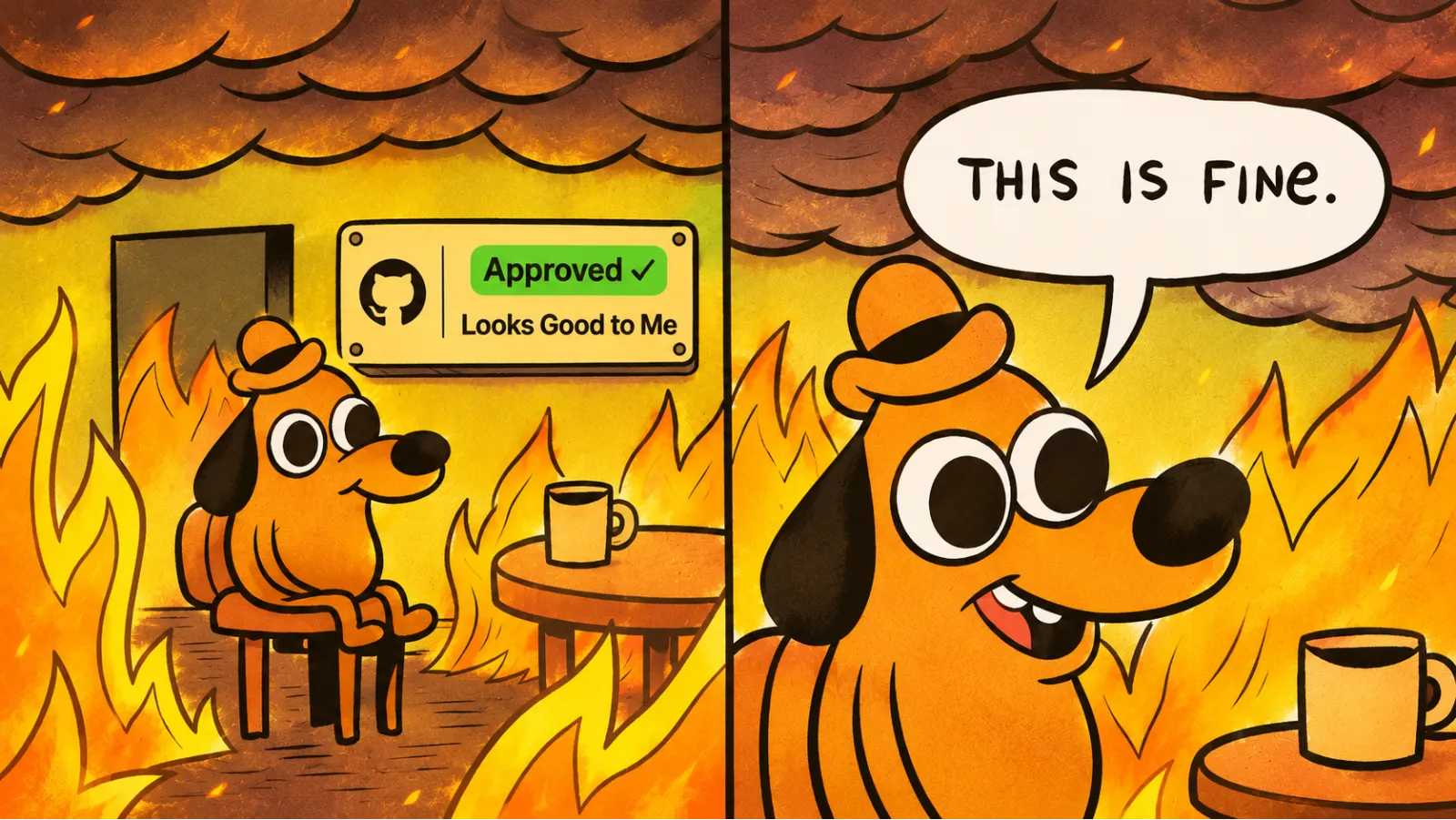
A pull request lands in your inbox. 47 files changed. 1,212 additions. 388 deletions.
You open it. You scroll. You scroll a bit faster. You see some green, some red, a renamed folder, and a package-lock.json the size of a small novel.
You type four letters.
LGTM (short for "Looks Good to Me").
Approved in nine seconds. Personal best.
Be honest. You did not read it. You checked that it had a description, that CI was green, and that the person who wrote it seemed confident. That is not a code review. That is a vibe check with a green button.
The nine second approval
There is a famous joke that every developer has seen and every developer has lived.
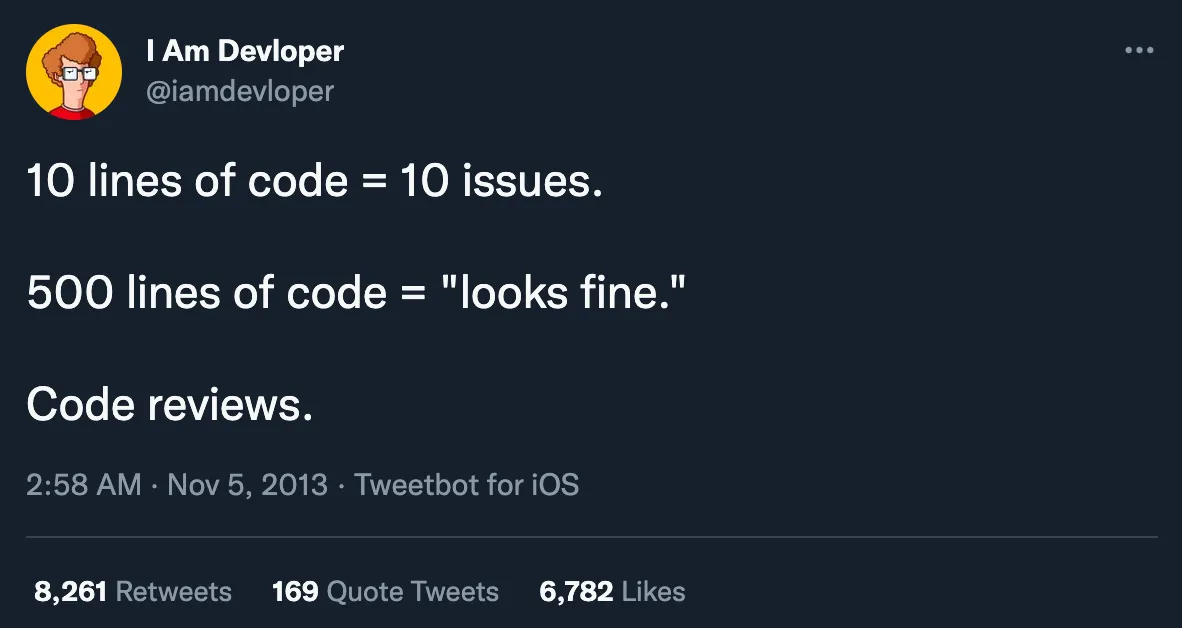
Ten lines? You will find eleven problems. A variable named data2. A missing semicolon in a codebase that does not use semicolons. A strong opinion about whether this should be a map or a forEach.
Five hundred lines? Looks great. Ship it. No notes.
The funny part is this is completely rational behaviour. A small diff fits in your head. A giant one does not. So your brain does the efficient thing and gives up, and then dresses that up as trust.
"I'm sure they tested it."
They did not test it. They also typed LGTM on your last PR.
What a review is actually for
Somewhere along the way, code review turned into a formality. A box you tick so the merge button turns green. A tiny bit of bureaucracy between you and production.
It is supposed to be the opposite. It is the last time a human looks at this code before real users do.
A review is not there to check whether the code runs. CI already told you that. A review is there to catch the things CI cannot:
Does this actually solve the problem? Not "does it compile". Does it do the thing the ticket asked for, or the thing the author assumed the ticket asked for?
What happens on the bad day? Empty list. Null user. Two requests at the same millisecond. The API that times out. Happy paths always pass review. Production does not live on the happy path.
Can someone else maintain this? In six months, someone who has never met the author will open this file at 2am. Will they understand it, or will they rewrite it?
Did anything sneak in? A hardcoded key. A console.log with a user's email in it. A new dependency nobody asked for. A TODO that is going to outlive all of us.
If you did not think about any of these, you did not review it. You just watched it.
The other side: your PR is unreviewable
Now the uncomfortable part. Sometimes the reviewer is not lazy. Sometimes your pull request is just impossible.
You opened one PR that fixes a bug, renames three folders, upgrades React, reformats every file because your editor felt like it, and adds a dark mode nobody asked for. The title is "updates". The description is empty.
Brother. That is not a pull request. That is a hostage situation.
Nobody can review that properly. So they don't. They type LGTM, and now your bug is their bug too.
If you want a real review, make your PR reviewable:
One PR, one job. The bug fix goes in one PR. The folder rename goes in another. The formatting change goes in a third, ideally never.
Write the description like the reviewer is smart but busy. What was broken, what you changed, how you tested it. Three lines is enough. Zero lines is not.
Show it working. A screenshot for UI changes. The command you ran for backend ones. Make it easy to believe you.
Review your own diff first. Open the files changed tab and read it like a stranger. You will find your own console.log('here2') before anyone else has to.
How to review without being the villain
The opposite of LGTM is not leaving 74 comments about trailing commas.
There is a special kind of reviewer who reads a pull request like they are grading an exam they want you to fail. Every comment is a question that is actually an insult. "Why would you do it this way?" Nobody has ever felt motivated by that sentence.
Good reviews are boring and kind:
Separate the blockers from the nitpicks. Prefix the small stuff with "nit:" so the author knows what actually matters.
Ask real questions. "What happens if this list is empty?" is useful. "Did you even think about empty lists?" is just you being annoying in writing.
Say what is good. If the author did something clever, tell them. It costs nothing and it is the only part of the review they will remember fondly.
Pull it and run it when it matters. Reading code is good. Clicking the button is better.
And if you genuinely do not have time to review it properly, say that. "I can only skim this today" is honest. LGTM on something you did not read is a lie with a green tick on it.
Where Forke fits
On Forke, every bounty ends in a review. A real one.
Your pull request goes into somebody else's codebase, and somebody who actually depends on that code has to read it and approve it before you get paid. Nobody is typing LGTM to be polite. If it is a 900 line mystery box with "fixed stuff" as the description, it is coming back to you.
That is the point. Writing code that works is half the job. Writing code that a stranger can read, trust, and merge is the other half, and it is the half nobody teaches.
So the next time a pull request lands in your inbox, actually open the files. Ask one real question. Run it once.
And the next time you open a pull request, make it small enough that someone can.
LGTM is a lovely phrase.
Just make sure it is true.