
Open your terminal. Go to any project you have touched in the last year. Type this:
git log --oneline
Now read it out loud. Slowly.
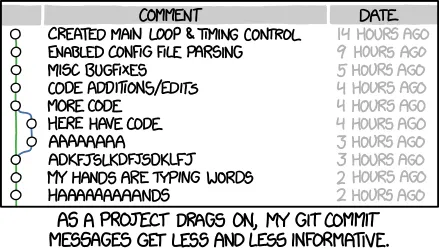
fixfix againasdffinalfinal finalplease workok now it works.
That is not a history. That is a ransom note.
And it never matters. Not today, not tomorrow, not in the sprint review. Nobody reads commit messages. Until one night, they become the only thing anyone reads.
The 3am git log
It is 3am. Production is down. Checkout throws a 500 for every user with a saved card, and the Slack channel has gone from "hey quick question" to all caps.
You find the file. You find the line. Somebody changed how the amount gets rounded. You run git blame to find out why.
The commit says stuff.
The author is you.
Eight months ago, you knew exactly why that line changed. There was a bug, a customer email, maybe a tax edge case in one state. You had the whole story in your head. And you wrote one word, because you were in a hurry and the message box felt like paperwork.
A commit message is a letter to a stranger
Here is the thing nobody tells you when you learn git: the code already says what changed. Anyone can open the diff and see that line 42 now uses Math.floor instead of Math.round.
What the diff can never tell you is why.
Why floor and not round? Was it a bug, a business rule, a regulation, a workaround for a library that rounds the other way? Is it safe to change back? The person debugging at 3am does not need to know that you touched line 42. They need to know whether line 42 is load bearing.
That person is a stranger. Sometimes it is a teammate who joined after you left. Sometimes it is the open source maintainer reviewing your pull request. Most of the time, it is you, six months older, with no memory of any of this.
Write for that stranger.
What a good one actually looks like
You do not need a 40-page style guide. You need five habits:
Subject line under about 50 characters. It shows up in
git log --oneline, GitHub's history and every tool you will ever use. Make it fit.Write it as a command. "Fix rounding on saved-card checkout", not "Fixed" or "Fixes" or "fixing stuff lol". Read it as "this commit will…" and it should make sense.
Say why in the body. One blank line after the subject, then two or three sentences: what was broken, why this fixes it, anything surprising.
One commit, one change. If the message needs the word "and", it probably wanted to be two commits.
Link the context. The issue number, the ticket, the customer report. Future you will click it.
Put together, it looks like this:
Fix rounding on saved-card checkout
Stripe expects amounts in paise. We rounded the converted amount, so ₹499.995 became ₹500.00 and the charge failed for saved cards only. Floor it instead, matching what the invoice shows. Closes #214.
Four lines. Thirty seconds to write. It will save someone an entire night.
"But I squash everything anyway"
Fair. A lot of teams squash merge, and nobody cares about your 14 work-in-progress commits on a feature branch. Commit wip as many times as you like while you are working. That is what branches are for.
But the squash does not delete the problem. It moves it. The pull request title becomes the commit subject, and the description becomes the body. So the same rules apply, just one level up. A pull request called updates squashes into a commit called updates, and that is what lands on main forever.
If your workflow keeps history, clean it up before anyone else sees it. Run git add -p to stage one logical change at a time, git commit --amend to fix the message you just regretted, and an interactive rebase to squash your five fix typo commits into the change they belong to.
Let the robots help, not write it
Yes, your editor can generate a commit message now. Click the sparkle, get a tidy paragraph, ship it.
Use it as a draft if you like. But read what it wrote. AI-generated messages are very good at describing the diff, line by line, in perfect grammar. "Updated the rounding function to use Math.floor and adjusted the related test." Thanks. I could see that.
The one thing it cannot know is the why. The customer email, the tax rule, the Slack thread where you and the payments team argued for an hour. That lives in your head, and the commit message is the only place it can be written down before it disappears.
If you want more git tricks that make your history cleaner without making you slower, Fireship covered a dozen of them in about ten minutes.
Where Forke fits
On Forke, your commits are not just for you.
When you claim a bounty, your pull request lands in somebody else's codebase, and the owner reviews it before you get paid. They read the diff. They read the description. They read the history. A branch full of asdf and final final makes a reviewer slow down and start doubting everything. A branch that explains itself gets reviewed faster, merged faster, and paid faster.
It also sticks. Every task you ship on Forke becomes part of your record, and "writes code other people can understand" is the skill owners hire for twice.
So the next time you type git commit -m, stop for five seconds. Say what changed. Say why. Write it for the person reading git log at 3am.
There is a very good chance it is you.