You are not stuck, you are just not reading the error message
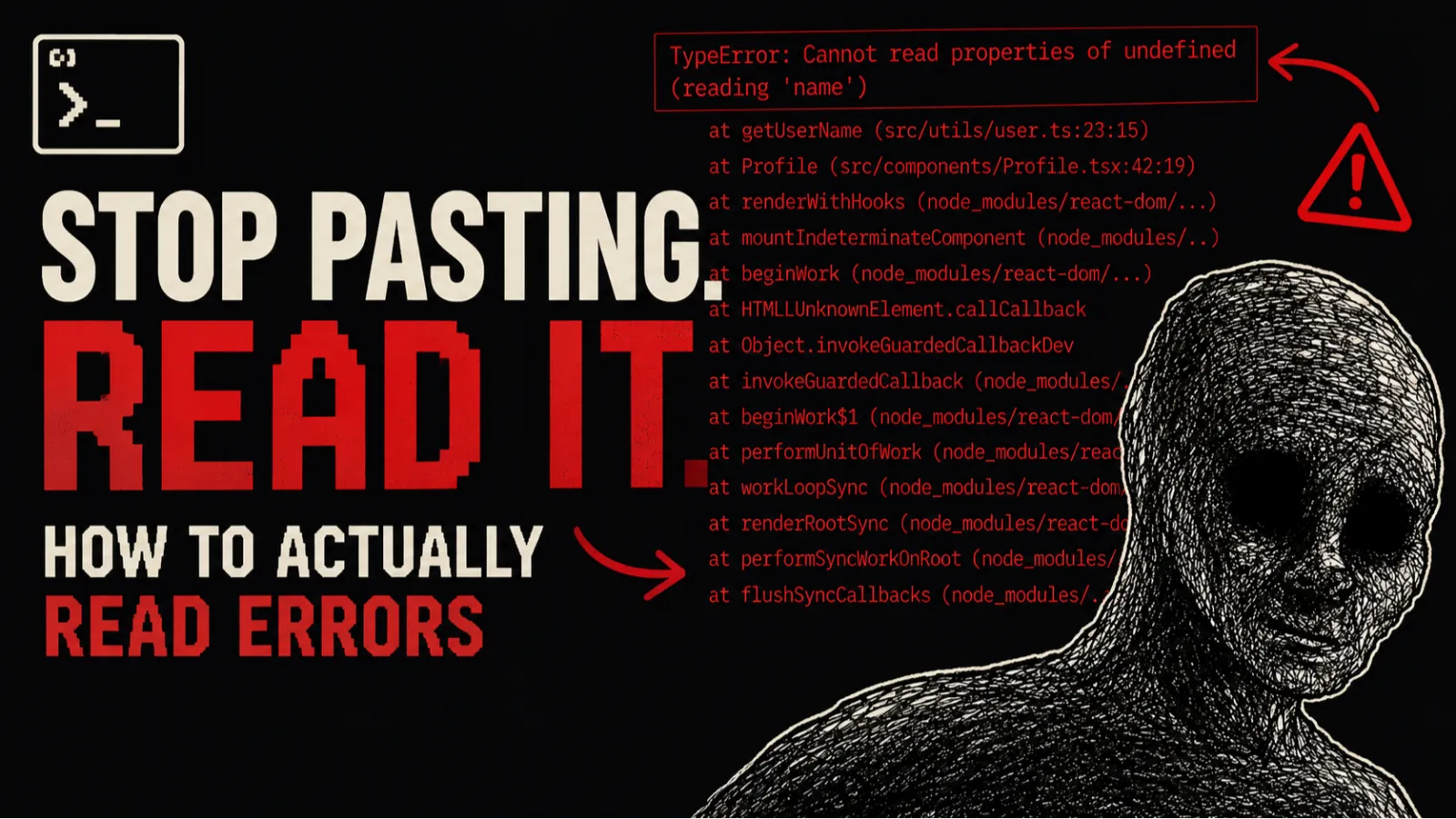
The error appears. Forty lines of red. Your eyes do the thing where they scan it without actually reading it, the same way you scan a cookie banner, and before you have understood a single word of it you have already selected the whole block, copied it, and pasted it into a chat window under the message "why is this happening".
Be honest about the timing there. You pasted it in under two seconds. You did not read it. You forwarded it.
The frustrating part is that the error almost certainly told you the file, the line number, and what it expected to find. It just said it in a format nobody ever taught you to read, so you learned to treat it as one large object called "an error" rather than a sentence with information in it.
Nobody teaches you to read the red text
Someone taught you syntax. Someone taught you what a for loop was. Tutorials walk you carefully along the happy path where the code works, because a tutorial where things break for nine minutes is a bad tutorial.
So the entire skill of "the program is broken and is currently telling you why" gets picked up by osmosis. Or not at all.
And errors do not help their own case. They print in red, which your brain files under danger. They are forty lines long, thirty five of which are file paths from inside node_modules. They are formatted for machines.
It looks like noise. It is mostly noise. But it is noise wrapped around a single useful sentence, and the whole skill is knowing where that sentence lives.
How to actually read a stack trace
A stack trace is two different things stapled together, and people fail to read it because they treat it as one thing.
The first line is what happened. TypeError: Cannot read properties of undefined (reading 'name'). That is the entire error. That is the sentence.
Everything underneath it is where it happened, listed backwards. The top frame is the function that blew up. The one below it is whatever called that. And so on downwards until you reach whatever kicked the whole thing off.
Here is the part nobody tells you: most of those frames are not your code. They are framework internals and dependencies you have never opened. Scan down the list and find the first line containing a file path that you wrote. That is your way into the problem, and nine times out of ten the bug is on that line or within three lines above it.
That is it. First line for the what, first line of your own code for the where. The rest you can ignore forever.
Read the first error, not the last one
You run the build. Two hundred lines of output. You scroll to the bottom, because the bottom is where your cursor already is, read the last error, and start fixing that one.
The last error is usually a consequence. One file failed to compile, so the next could not import from it, so the one after that had no types, and by the end the compiler is complaining about something four files from anything you touched.
Scroll up. Fix the first thing that went wrong. There is a genuinely satisfying moment where you fix one error and fourteen others vanish with it, and it happens far more often than you would expect.
What "undefined" is actually telling you
Take the most common error in JavaScript:
Cannot read properties of undefined (reading 'name')
People read this as "something is broken". That is not what it says. It is being weirdly, helpfully precise.
It is saying: at this exact line, at this exact moment, the thing to the left of .name did not exist. Not a wrong value. Not an empty string. Nothing was there at all.
Which turns your question into a much better one. Not "how do I fix this error", which is unanswerable, but "why was that undefined right there". A few candidates:
The data had not arrived yet. You are rendering before the fetch resolved.
The shape was not what you assumed. The API returns
{ data: { user } }and you reached foruserdirectly.You spelled it two ways.
userIdin one file,user_idin the other. Both look correct in isolation.The function returned early. There is a guard clause near the top that you forgot you wrote.
Every one of those is a specific thing you can check in about a minute. "How do I fix this error" is a thing you can guess at for an hour.
And optional chaining will make the red text go away. It will not make the data show up. If you ?. your way out of this you have not fixed the bug, you have muted it, and it returns later as a blank screen with no error at all, which is considerably worse.
You are not stuck. Something you believe is false.
Here is the reframe that changed debugging for me.
When you are stuck, it almost never means the problem is hard. It means you are holding an assumption about your own program that is not true. You believe that variable has a value in it. You believe this function runs before that one. You believe the request went out with the header attached.
One of those beliefs is wrong. Debugging is the process of finding out which one.
Which is why you cannot solve it by thinking harder from across the room. You have to go and check. Log the variable one line above where it exploded and look at what is genuinely in it, rather than what you are extremely confident is in it.
console.log is not beneath you. Every senior developer you have ever respected has a console.log("HERE 3") sitting in their working tree right now.
About that paste reflex
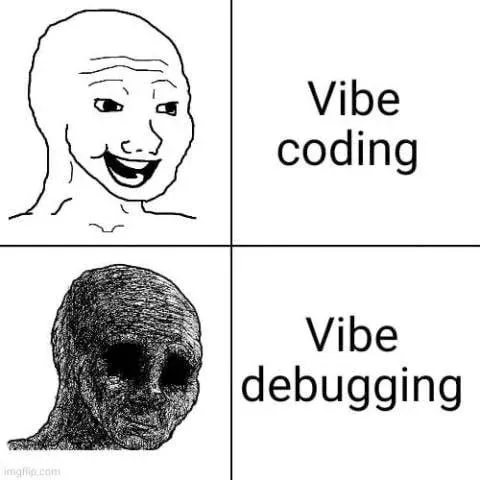
I said at the top that you forwarded the error instead of reading it. The fix is not "stop using AI". Obviously use the AI.
But notice what you handed over. The model does not have your runtime. It cannot see what was in that variable or what your API actually returned. So it does the only thing available to it, which is match your error text against every similar error it has ever seen and hand back a plausible fix for a very similar bug.
Sometimes that is your bug. Often it is a cousin of your bug, and you spend the next forty minutes carefully applying a correct solution to a problem you do not have.
Read it first. Thirty seconds. Form one theory. Then bring the AI in with the theory attached and you get a completely different quality of answer, because now you are asking a question instead of forwarding a complaint.
Where Forke fits
This stops being a nice-to-have the second you are working in a codebase you did not write.
On a bounty you have no mental model of the repo, nobody at the next desk who remembers why that module is like that, and a stack trace pointing at a file you have never opened. There is no "ask the person who wrote it". The error is the only thing in the room that knows what actually happened.
It is also, quietly, what reviewers notice. A fix that addresses the actual cause reads completely differently from a fix that just makes the symptom stop.
So next time the red text shows up, do the unnatural thing. Do not copy it. Do not paste it. Read line one, find the first file that belongs to you, and go look at what is really in that variable.
The error message has been trying to tell you since the first time you did not look.