The "Trust me bro " Tech Stack
Okay, real talk. Ask ten people what their stack is right now and you’ll get two totally different answers. Some are still building on the boring, battle-tested stuff. Others are basically running on Claude, Supabase, v0 and a Vercel deploy, and honestly half the time it ships fine. That gap is what we want to talk about.
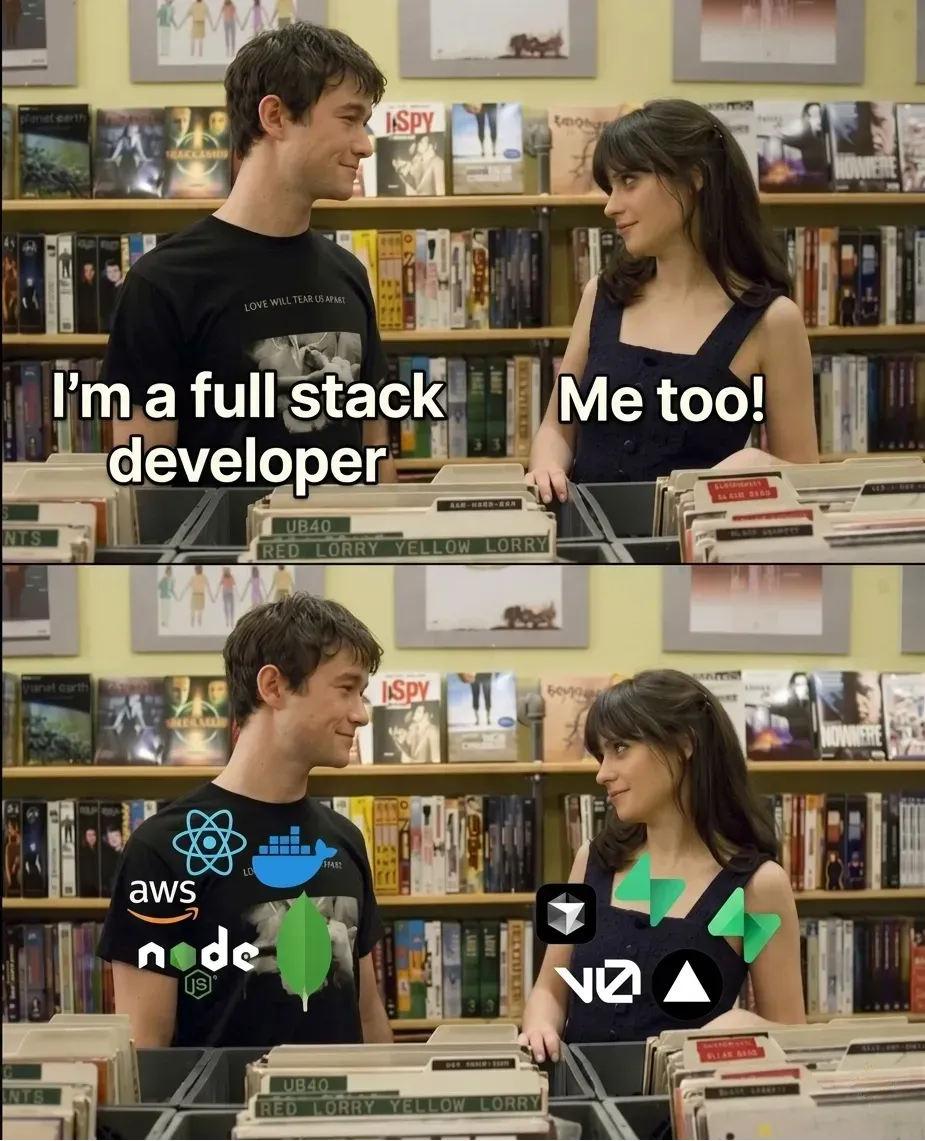
And look, we’re a team that ships with AI every single day, so this is not a “kids these days” rant. The point isn’t “AI bad.” The point is that the tools you reach for first quietly become the only tools you know. A lot of people are speedrunning straight into a stack that was never built to survive contact with real users.
The hype stack vs. the boring stack
There’s nothing wrong with Supabase or v0 or shipping on Vercel. We use plenty of it. The problem is when the AI picks your entire architecture for you and you never ask why. You typed “build me a SaaS,” it scaffolded the trendiest thing in its training data, and now that’s your stack. Not because it fits the problem. Because it autocompleted.
The boring stack looks slower for about a week. A real database you understand, auth you can reason about, a deploy you could debug at 2am. Then the hype stack hits its first weird production bug and the gap flips. Hard.
“It works in the demo” and “it survives real users” are two completely different claims. AI is incredible at the first one and has no opinion about the second.
Meaningful beats impressive
A meaningful app solves a real problem for a real person who’d be annoyed if it disappeared. An impressive app gets 40 likes on a screenshot and never sees a second user. AI is dangerously good at helping you build the second one, because a slick demo is exactly the kind of thing a model can one-shot.
So before you let it generate a single file, answer the unglamorous question: who is this actually for, and what breaks in their life if it doesn’t exist? If you can’t answer that, no stack is going to save the project. Trendy or boring.
Watch this if you want the experienced-dev version
We’d rather point you at someone who codes with AI all day and is honest about where it helps and where it bites. Theo’s take here is basically the whole post in video form. How to actually use AI to build real things without outsourcing your judgment to it:
How to use AI and still end up with something scalable
None of this means slow down or write everything by hand. It means stay the one driving:
Pick the stack, then let AI fill it in. Decide your database, auth, and hosting like an adult, then use AI to move fast inside those choices. Don’t let “whatever it scaffolded” be the architecture.
Ask “what happens at 10,000 users?” Make the model defend its choices. If the answer is hand-wavy, that’s a tell. Scalability is a question you ask on day one, not a rewrite you do on day 200.
Understand the data layer yourself. This is the part that bites hardest later. If you can’t explain your schema and your queries without the AI in the room, you don’t have a product. You have a liability.
Boring where it counts. Use the trendy tool for the fun 80%. Keep the parts that hold your users’ data and money on stuff that’s been battle-tested by a million people before you.
Where Forke fits
Here’s the thing a screenshot can’t give you: proof that you can build something a real person depends on. On Forke you claim a real task, ship it, and someone approves it with money on the line. That means the work has to actually hold up, not just demo well. That’s the loop that turns “I vibe-coded an app” into “I can build things that don’t fall over.”
So use the AI. Use the trendy tools where they earn their spot. Just don’t let the autocomplete pick your whole stack, and don’t confuse impressive with meaningful.
Build the thing someone would actually miss.